More news from the European Commission about how it plans to foster research in the European Research Area.
Science and Research Commissioner Janez Potocnik explained that 'Europe needs more research, but we will never have more research without more researchers'. Potocnik is taking advantage of the Summer Pause to promote the European Network of Mobility Centres (ERA-MORE), which aims to get researchers moving around Europe.
This is a great endorsement for increasing European research efforts but I miss, a little bit, a focus on quality.
It's heady stuff, but then that is never really in short supply in these kinds of announcements. Another memorable one was Potocnik's recent declaration that knowledge should be a "fifth freedom of movement" in the EU after the free movement of goods, services, capital and labour.
29 August 2007
'More' should mean 'better' in research...

30 July 2007
US joins the Basel II party
The Federal Reserve, Federal Deposit Insurance Corp. and other US financial institutions issued a joint statement on July 20th saying that they would join Basel II, a key global accord of financial regulatory bodies that has been hammered out in the Swiss city of Basel.
Various sticking points prevented the US from coming to the table, despite the fact that European and Asian economies had signed up more than a year ago.
At the core of Basel II is a promise from Banks to put aside capital reserves as protection from serious loses. The accord has been drawn up against a backdrop of financial deregulation over the past 15 years, and is seen by many as a critical guard against a global financial meltdown.
Basel II features a cocktail of complex methods for calculating the value of bank reserve assets, including novel methods to assess the riskiness of the reserve assets themselves. The complexity of these methods have created much hand-wringing debate. It was the techie, quantitative side of Basel II that drew my own interest.
Early on, the financial community feared that Basel II would bloat capital requirements and threaten bank competitiveness. Interestingly, one of the final sticking points for US participation was that the capital reserves would actually be lower under Basel II.
Thus, it was the Federal Deposit Insurance Corp. that threatened a veto, because Basel II would allow banks to hold lower reserve assets than those stipulated by existing US Bank lending rules.
The 12 large banking institutions in the US that will now comply with Basel II will also remain bound by the so called leverage ratio, a government imposed lower limit to the proportion of assets that banks are entitled to lend. With an agreement on this additional claus came the final settlement for US membership.
Earlier in the month, Middle East financial institutions made an announcement about their own progress with Basel II. A roundtable discussion involving financial representatives of the United Arab Emirates highlighted vulnerabilities in operational risk, i.e. risks associated with failures in systems, processes and people. A press release issued by the roundtable explained that regulators in emerging economies "lack credible, quality data" with which to evaluate their financial risk.
Basel II, the UAE roundtable argued, could be a source of competitive advantage for emerging economies by increasing banking efficiency and productivity. All of which is good news for those at the Bank of International Settlements in Basel, who can now count all major European economies, Japan and now the US at the Basel II table.
18 June 2007
Gain or pain?
The European Research Council (ERC) received 9167 project proposals for its new Starting Independent Investigator Grants. With a significant portion coming from outside Europe, the ERC hailed this tsunami of interest in its new research funding scheme as hope for a "brain-gain" to counter years of European brain drain.
Anyone can apply for the grant as long as they are based in an EU country during the funding period.
But with a budget of €290 split across all research domains, not to mention the arduous task of sifting through nearly 10000 grant proposals, I wonder if the scheme will be a bit over stretched?
It really is a lot of proposals. A lot of effort on the side of the applicants. I would wager that this interest is driven by falling US grant acceptance rates more than anything else.
How will the ERC carve up its relatively petite spoils? Who is going to suffer through the evaluation of those many thousands of eager applicants?
What is missing, for my taste, is a research focus; say medicine or social sciences. And there should be at least some evidence that the ERC will garner together expertise to judge the successful proposals. Otherwise I fear an outcome involving more pain than gain.
14 May 2007
Money isn't everything in research
China is awash with new cash to spend on research, Nigeria has a $5 billion trust to develop applied technologies and India boasts over 20 000 pharmaceutical startups alone. But still it seems there are some things that research money can't buy.
China and India are emerging as places where money is no issue when it comes to research. The Chinese Ministry of Science and Technology just announced that more than a billion yuan (US$130 million) will fill the coffers for research into traditional chinese medicine (TCM).
That is 5-6 times the previous spending round. A further 8 billion yuan has been allocated to the health budget for traditional medical treatments. Yet beneath this rain of additional funding, skeptical voices can be heard. China is being questioned about the way the money will be spent, and its medical safety record is poor.
There's no evidence that things will improve by simply spending more. And according to an editorial in the April 5th edition of Nature, China's share of the global market in TCM is being eroded by Japan and South Korea. There, cash flows at a reduced pace but the quality is better.
Affordable, but not ethical
Biotechnology is booming in India and investors are flocking to the generics market, that is, to the production of drugs that are no longer covered by patents. But some are uncomfortable about this boom taking place alongside India's yawning economic disparities.
Sanofi Aventis Chairman Jean-Francois Dehecq denounced the pharmaceutical industry in India, Thailand and Indonesia in an interview with Reuters in January. He said local producers are "exploiting people" and then selling drugs cheaply to those that "can already pay".
This is an issue of opportunity cost. Foreign and domestic players are queuing to invest in the pharmaceutical sector. But with such handsome profits to be made from cheap copies of popular drugs, little investment is finding its way to research.
Finally, there is the dicey situation in Nigeria. Riding on the back of abundant oil revenues, outgoing president Olusegun Obasanjo recently endowed $5B for science and technology. That's enough for a research budget more than twice that of relatively well-off South Africa.
Combined with co-financing from businesses and international aid organizations, Nigeria could afford a program on a par with many nations in the developed world. But these plans are clouded by the country's bottom 6th ranking on the global Corruption Perception Index.
The UN Educational, Scientific and Cultural Organization (UNESCO) is bracing itself to ensure the money goes to vitally important research in health and agriculture. But no one is holding their breath for the spending boost that outside partners would bring.
Thus, even with a supreme effort to allocate funds wisely, the Nigerian government is unlikely to get the same benefit from its investment that could be obtained in a more politically stable environment.
These three examples tell the same story. China, India and oil-rich Nigeria currently have the cash and the will to fund research. But they are likely to struggle to realize the full potential of this enormous additional funding.
18 April 2007
Slow and steady...doesn't always win the race
Humans currently live on the North side of the Earth's sustainable limits, running up a growing debt with the environment. Our approaches to fighting climate change apparently fail to account for the growth of this debt.
You might have missed news about the recent Global Roundtable on Climate Change, which brought together prominent business leaders to summarize the view of big business on the issue.
The last big business story about climate change was Chrysler's chief economist Van Jolissaint opining, at the January Detroit Motor Show, that it was all in the imagination of 'quasi-hysterical Europeans'.
The story of the Global Roundtable makes better reading. After much deliberation, the Roundtable published its views in a document called The Path to Climate Sustainability. It describes a course of action to curb global resource use and waste production to within sustainable limits.
An exclusive club, its members boast great confidence in the endeavor. Quotably, General Electric CEO Jeff Immelt says that 'global businesses are assuming their just place as catalysts for action on climate change', and that political leaders are "lagging behind".
Immelt is right to highlight the problem of lagging behind.
Lags are a no-no when it comes to moving along a path to sustainable limits. Why? Because if you lag behind long enough, the sustainable limits will themselves change substantially, and move further away from your well intentioned path.
The basic idea is simple: if you lag behind in your debt payments, debt grows larger, forcing up the cost of repayments. The longer we spend sitting around planning the path to sustainability, the less likely we'll reach the goal.
26 March 2007
Netherlands creates Minister for Research
Sustaining research funding in Europe remains complex and challenging. Solid representation in Government is probably the only way to secure a future for innovative research.
Good news from the Netherlands. It has created a new minister for research and universities. Molecular biologist Ronald Plasterk will fill the new post, bringing experience as a top flight researcher as well as nearly 10 years of involvement in Dutch politics.
I met Plasterk more than a decade ago at a residential training course at the Cold Spring Harbor Laboratory (Long Island, NY). The workshop brought together everyone from PhD students (like me at the time) to professors to learn a new technique aimed at discovering genes involved in learning and memory.
Plasterk was already a rising star back then, having just returned to the Netherlands to start his own research group after postdocs in the US and UK . I remember him as open and friendly, participating in the lab work with as much enthusiasm as the PhD students.
News of Plasterk's appointment came at the same time as a squabble in the UK about research funding. The Department of Trade and Industry (DTI) had just announced that £65 million of funding initially allocated to research had instead been spent propping up the Rover car company and maintaining Britain's aging nuclear energy infrastructure.
The DTI blithely announced the funding cut as a mere budget reallocation from one division to another. But as Biotechnology and Biological Sciences Council head Professor Julia Goodfellow explained, "science and innovation is about the medium term. If you start cutting it because of short term need then you have real problems".
Medical Research Council head Professor Colin Blakemore agrees. In an interview with the BBC he explained that "it might be time to take science funding out of the DTI's hands". There was a need, he said, for "science to be handled and administered really quite distinctly and separately from the rest of government".
Out of sight, out of mind
The report on the BBC website described the general downward trend in scientific research funding in the EU. The editorial suggested that the cause of this was "the switch away from manufacturing [in Europe], the industrial sector that does the most R&D".
This is an insightful remark.
Has there really been a disruption in the natural flow of funds between the consumers of innovation, i.e. manufacturers, and the producers of innovation, researchers? Who could have predicted that relocating manufacturing outside of Europe could disrupt this flow?
27 February 2007
Intensive Pharming
Drug companies are engaged in a relentless drive to improve the productivity of their research activities. Intent on simplifying organization structures and speeding up the decision making process, what kind of results can we expect from this more intensive approach to the cultivation of new medicines?
February has been eventful in the world of pharmaceutical research policy. Pfizer and Roche both made bold announcements about their future research strategies, promising a simplification of the way research activities will be organized. And both their strategies involve thinning out middle management so that strategic decisions can be taken faster.
Pfizer's 2005 research budget was the second highest corporate research spend ever and a full 20% larger than its nearest rival in the pharmaceutical sector. But that ranking is unlikely to survive the lab closures and cuts to research staff that are currently in the works.
Scientific domestication
Research at Pfizer will ultimately be concentrated at 3 global centres. The company will focus on just 10 diseases, directing individual research teams to focus exclusively on one disease. This reorganization will result in the weeding out of Pfizer's research centre in Ann Arbor, Michigan, the laboratory that discovered Pfizer's blockbuster cholesterol lowering drug Lipitor.
Commentators have cautioned against organizing drug research into individual diseases, arguing that this prevents valuable synergies between therapeutic areas. February's edition of the journal Nature echoed this sentiment with a quote from University of Michigan's Alan Saltiel saying "A lot of drug discovery is serendipity".
All this seems like a large number of scientists to shepherd along such a defined path. And given the intensity with which this path is being pursued, it could take a long time to turn back if anyone should discover that serendipity is needed after all.
22 January 2007
Risky business
My google alerts recently unearthed a 2005 study by Tufts University on the efficiency of drug research and development. One of its findings was that economics considerations account for more than 35% of the attrition rate of drug candidates in development.
When a drug fails, the event makes news. We generally only hear about failures due to safety or efficacy concerns. Economic factors are rarely given as the reason for the failure.
The Tufts study explains that "rapidly rising R&D costs has led economics to gain ascendancy as a major reason for killing unpromising products in the R&D pipeline".
I find this explanation intriguing. The rising cost of development is not a new trend. Costs have been rising steadily, and returns falling steadily, for years. Does the Tufts study reveal the rise of a new cause of drug attrition in development or simply a fall in investor confidence and loyalty?
24 December 2006
A year in review
It being year's end, I'd like to reflect on what has gone into this blog. I began with a broad agenda to advocate research and describe research efforts around the world.
I followed a few hot topics, for example biodiversity and the application of systems biology to biomedical research. But science communications is just one facet of my blogging interests.
I am also interested in the centers that do the research, and especially, the research policy behind these centers. I am keen to compare the policy experiments in Europe, the US and Asia.
Places like Biopolis, in Singapore, are successfully forging links between government and industry to support research. Biopolis is well funded and now employs high calibre researchers trained in Europe and the US.
Attempts to fund research with joint public/private partners can be found everywhere. Biopolis represents one approach to joint funding, with research interests extending across the biological sciences.
Another approach is found at the Kluyver Centre in the Netherlands, which focuses on a particular application, namely industrial fermentation. Kluyver's strategy has also been successful, as is evident from the generous support added by its new industrial partner Tate and Lyle.
I learned a lot while writing this blog. I discovered Euractiv, Cordis and AlphaGalileo, three excellent news distribution organizations with a focus on research news. Euractiv and AlphaGalileo are independent, while Cordis is an official news channel for European Commission research activities.
All three channels are rich sources for breaking news about scientific discoveries and for science policy developments. I gained from them a steady stream of facts and figures with which to form opinions about European research.
What defines a good research environment? Should research be conducted in fast- paced research hotels with precise goals and short to medium term time horizons? What role should institutes and university faculties play in research?
Should research aim to bring a direct commercial benefit to the funding agencies that support them? Should the private sector pay for fundamental research, or should it become involved only during the final commercialization phase of research and development?
These are key questions towards understanding where research is headed, and the kinds of research cultures we should expect to see in future.
21 November 2006
Europe a laggard in research?
Europe is sometimes described as a laggard when it comes to the commercialization of intellectual property. New research comparing technology transfer on both sides of the Atlantic shows that the reality is rather different.
Researchers at the United Nations University (UNU) recently published what they believe is the first critical comparison of patent and commercialization activity between Europe and the US. They sought to shed light on the so-called European Paradox, the notion that Europe has good ideas but doesn't make any money from them.
They find that for every million dollars invested, Europe produces 20% more licenses, 40% more startups and earns within 10% of overall return on investment enjoyed by investors in the US. Measured in terms of these formal forms of technology transfer, Europe is not such a laggard after all.
In characteristic self-deprecating fashion, the European researchers hail the findings as a warning rather than a sign of success. They believe Europe may be focusing too much on formal technology transfer, in turn threatening the open exchange of ideas.
Borrowing from the language of software development, the UNU publication calls for a strengthening of Open Source Science, that is, for greater sharing of basic knowledge and intellectual property.
The US, they believe, is actually much stronger in this regard. Despite an explicit orientation favouring the Market over sharing, technology transfer in the US is conducted with a strong orientation towards sharing knowledge.
If anything, this is the paradox that deserves attention. How is that the country that believes in unfettered competitiveness could simultaneously be home to the planet's greatest achievements in open source software?
Might this come down to the difference between talk and action?
I recently attended a public lecture in Zurich, Switzerland, in which talk and action came into sharp contrast. A member of Switzerland's seven-member governing committee was warmly acknowledging Europe's communitarian instincts.
The Swiss governor explained that competition created jealousy, and that jealousy wasted precious human energies. Much better to do research as a network and share, said the Governor.
There followed a talk by a high profile Harvard professor. He began with the words "I luuurve competition". The lecture hall froze as he described how competitiveness was the foundation of the US dominance in research.
The Swiss Governor's face tightened visibly.
But as the Harvard professor went on it became clear that competitive advantage was not the only factor behind the US's superior research profile. The professor acknowledged a much simpler, and insidious factor behind US successes.
That factor was access to journals.
US journals, he acknowledged, had a clear bias towards US research. Everyone else was somewhat off the radar, he explained.
You can talk the talk, but the action came down to jealous US journal editors.
Talk. Action.
If the US can't resolve the disparities between the two, let's hope Europe can, and that Europe's Open Source Science will flourish.
19 November 2006
Filling the gap between R&D and commercialization
The European Institute of Technology (EIT) moved back onto the agenda on October 18th with the publication of a revised proposal for its funding and organizational structure. According to its supporters, the EIT will bridge the gap between Europe's rich knowledge-base and commercially valuable innovation.
What began as a plan to create Europe's answer to the MIT has now changed considerably. In the new proposal, the EIT is a two-tier institution comprising a small organizational body and a network of collaborative groups called Knowledge & Innovation Communities (KICs).
The KIC's comprise researchers and entrepreneurs employed at universities and other public sector bodies, and the private sector. They will be expected to come up with the innovation, as well as €2.1Billion of the €2.4Billion budget.
Industry and academic interest in the proposal is lukewarm. Industry groups wonder why they should give generously to something that is, in effect, little more than an administrative department of 100 people.
Supporters of the EIT battle on. One name that stands out at the moment is Polish MEP Jerzy Buzek. Buzek talks about Europe's poor ability to deliver innovation, by which he seems to mean, products and services that generate a direct profit.
"It is impossible to finance innovation directly through FP7", remarked Buzek in a reference to the EC's research funding program. He believes the task comes down to filling a gap between research and commercialization.
The EIT would fill this gap, claims Buzek, and would not participate directly in either research or education. This would create unnecessary competition between the EIT and Europe's universities and research institutes, he claims.
Some comment that the latest proposals for the EIT pose more questions than answers. Eurochambres, the 17 Million member association of European chambers of commerce raise several questions.
They believe the proposal lacks clarity about how the KICs will be organized. They also claim that the proposal leaves open the question of how the EIT will rate, and therefore rank, the projects it will become involved with.
Buzek claims these questions reveal the EIT's strengths rather than its weaknesses. On the issue of how KICs would be organized, Buzek believes that the innovation programs will benefit from being able to decide themselves on their composition and organization.
This is a curious response from Buzak.
If the EIT will not participate directly in research, then its existence will be justified in terms of its guidance in technology transfer and commercialization. Filling the gap and all that.
But if it cannot describe how those goals would be translated into some kind of organizational formula or plan, how can we evaluate its quality as an organisation? Seems that the gap between research and commercial success is as empty and unclear as ever.
31 October 2006
Around the world in patents
This month's international research roundup looks at patents, the deceptively simple method for earning money from ideas.
First stop India. India's Council for Scientific and Industrial Research filed 542 US patents between 2002 and 2005. With the cost of filing a patent standing at about $25 thousand, and maintenance costs of $4 thousand per year, it's no surprise that this feverish activity has come to receive scrutiny from a skeptical public.
Nature ran an editorial arguing that India's state subsidized program for registering US patents is being abused and having a detrimental effect on research. Successful patent applications have come to be used in leu of peer-review publications. They provide a short cut to promotion and grant success.
The Indian newswire teluguporta.com carried a story (September 7th) entitled "Public Money Wasted on Useless Patents". The story described a patent for a substance extracted from cow pee that purportedly conferred an antibiotic action. The claim was not supported by any experimental evidence.
Moving East to China. 20 Chinese delegates flew even further east to San Francisco on the 9th of October for a training course on intellectual property rights. The course was given by Berkeley's Haas School of Business, no less than a paragon of righteous money making.
The US, and Europe too, would like to curb infringements of their patents in China. Beyond platitudes about getting to know each other, the press release on the event mentioned the need to address "Chinese misunderstanding of US values and priorities".
Now let's spin the compass around to examine Europe and its West-ward gaze towards the US. Here the issue is not about policing patent infringements. It's about Europe's desire to replicate the US's success with making money from ideas.
What caught my eye recently was a report published by the EC in September about the benefits of intellectual capital reporting for small to medium sized enterprises (SME's). The EU is pulling hard on all the levers to help SME's. This particular was report gave the advice that "articulating intangible resources" (intellectual property) could drive value creation.
Unfortunately the report seemed to struggle to back the claim. It cited evidence that investors presented with information about a company's conceptual crown jewels were more likely to give the company a thumbs down, in the form of lower forecasts. And anecdotal evidence suggested that fund managers and financial analysts don't take the information seriously.
Keep pulling on those levers, everyone! After all, money makes the world go around.
23 October 2006
Productivity and Innovation
Briefly:
The focus on productivity issues in pharmaceutical research seems to ignore the trade off between efficiency gains and the investment required to refine production methods
---
Productivity is an oft used word. In drug research, it is the focus on nearly all discussions about how the pharmaceutical industry will cope with a combination of rising research costs and a downward trend in the number of drug discoveries.
If the goal is obvious, what then should be the approach to reducing the costs of discovering new drugs?
The logic of productivity is attractively simple. Reduce the cost of a single production step, and the overall productivity will rise. Want improved cupcake productivity? Then head over to the cake factory and have a detailed look at the process in which the ingredients are mixed, placed in a small paper cup, cooked, packed, and distributed.
None of this is rocket science. Or even science. It's process engineering and the engineer's job is to study a process that works reasonably well and make it work even better.
An obvious difference between cupcake production and drug research is that between 99%-99.9% of the products will fail somewhere along the development "pipeline". As cupcake industry insiders will know, the occasional cupcake does go awry before it reaches the light of day. But nothing like 999 out of 1000.
Which pipeline?
Alarm bells should be ringing. Investment in productivity enhancement is a trade off between the cost of studying a process and the benefit of making the process work better. Drug discovery, indeed innovation in general, is just not the place for it. For those few successful drug research pipelines, the efficiency gains will pay out. But for the other 999 cases, the whole exercise is little more than a wasted overhead.
Once I thought that the productivity mantra was confined to the pharmaceutical trade press. Now I see that it dominates international research conferences and falls from the lips of research heads, even in private conversation.
Why focus on increasing the productivity of the drug discovery pipeline if it means that we will spend most of our time peering long and hard down the wrong pipe?
11 October 2006
Europe takes lead in safe chemical production
Briefly:
New safety rules applying to Europe's chemical industry will squeeze low value-added chemical production
The European Commission will shortly take the final vote on REACH, a brave new world in safety regulations for chemicals in Europe. The REACH initiative, which stands for Registration, Evaluation and Authorisation of Chemicals, aims to improve Europe's industrial competitiveness and prompt innovation towards the use of safer chemicals.
Industry has reacted strongly to the plan, which will require that as many as 100 thousand chemicals undergo a round of health and safety testing at the expense of manufacturers. Europe's chemical industry employs 1.7 million people and creates a trade surplus of €41 billion annually.
The Commission received 6000 responses from industry, NGO's and governments during a short consultation period in 2003. And a trial of the program in 2004, involving 29 chemical producers, spawned a report with more than 40 recommendations on how the program could me made "workable".
Of the two stated aims of REACH, the safety argument is mentioned most frequently in reports and press releases made by the Commission. One press release claims that safety information is "sketchy for around 99%" of chemicals in the market place, "raising questions about the possible impact on human health".
Supposing this is true, the question on my lips is how REACH will prompt innovation towards safer chemicals? The toxicologists I speak to are fairly divided about which direction this innovation could take. Some talk about the new field of toxicogenomics, which combines conventional toxicology insights with genome-wide experimental investigations.
Others talk of computational approaches involving machine learning algorithms, Bayesian prediction and other exotic methodologies. REACH makes no mention of these new methods. Indeed, the only statement I could find about how REACH would work in practice was a lonely objective that it should not increase the amount of animal testing.
Wading through the flurry of recent reports and press releases on REACH, I found a small section that compared the new proposals with the existing chemical safety rules. REACH will exempt chemicals used in quantities of less than 1 tonne from the new screening requirements. Currently, all new substances produced in quantities of more than 10 kilograms require safety screening.
With this change in policy, only 30 thousand of the 100 thousand chemicals classed as "sketchy" by the Commission will qualify for screening. So safety compliance will actually become easier under REACH, assuming today's annual production rates.
My guess is that this new rule will have an impact on the second stated aim of REACH, namely, improving Europe's industrial competitiveness. Many of the nano-particle producers should be able to satisfy demand by producing less than the 1 tonne annual threshold. An exotic component in a high-end memory device might weigh less than a microgram per unit.
The same rule will make large scale production of low added-value products unprofitable under REACH. That is because each product made currently could contain 10's or even 100's of individual chemicals that require testing under REACH. With testing costs eating into low profit margins, production is likely to move away from Europe.
So in summary, REACH looks to me like a friendly move for manufacturers of low-volume, high value-added chemicals. For my money, this could have a positive impact on Europe's tradition as a place of high value-added chemical manufacturing.
22 September 2006
Arise, European entrepreneurs
This month's international research roundup focuses on policies designed to foster entrepreneurialism in European research.
Ján Figel, the European Commissioner for Education, Training, Culture and Multilingualism called for stronger support for entrepreneurial mindsets through training and education. He cites figures showing that 60% of EU citizens had never considered starting a business and that 50% were overly averse to taking business risks.
Meanwhile the European Science Foundation has announced an new initiative to foster "a more coordinated approach to R&D investment", according to its Director, Wouter Spek. EuroBioFund will have an annual conference, this year in Helsinki December 14-15th, and separate divisions to take care of networking and brokerage, the organization of grass roots research communities, and joint investment and funding tasks.
EuroBioFund's launch has been timed to coincide with the inauguration of the EU's new Framework Program 7, due January 1st 2007. Organizers hope the initiative will re-dress fragmentation in the funding of life science research in Europe.
France declared a success of its public-private innovation and technology clusters, the 'poles de compétitivité', in a press release made on September 4th. The purpose of the Poles is to raise the international profile of French technology and promote regional growth and job creation in high value-added industries.
A total of 67 clusters, 6 of which were deemed internationally competitive, have been selected to share €1.5 over 3 years. The French government claimed that small to medium sized enterprises (SME's) account for 40% of the business beneficiaries. The money is split between corporate tax exemptions, lower social security charges and direct funding. Funding will cover up to 35% of R&D costs incurred by business partners.
Finally, the European Commission's (EC) plans to establish a European Institute of Technology met opposition from Euroscience, a grass-roots research advocacy organization with 2100 members across 40 European countries. Euroscience argue that the EC's proposal would not achieve its goals of promoting innovation and would ignore existing structural problems with academic research and education in Europe.
Euroscience cite large student numbers, dispersed research capabilities and "a serious lack of differentiation" among the woes of the existing research and education system in Europe. They call for centers of excellence and a more "bottom-up" research policy and believe the EC should instead establish a European agency that would stimulate innovative companies, provide training and foster technology transfer.
13 September 2006
A narrative, darkly
Nature published some interesting pieces on narrative over the last few months. What is narrative, you might ask. For me, it is the idea of sharing knowledge by telling a (true) story. I tend to see narrative as a way to help my audience understand and remember. But there is a darker side of narration, as Nature discusses.
The discussion (Nature 441, pp922) revolves around a new film, A Scanner, Darkly (Dir. Richard Linklater), which is based on a Philip K. Dick novel. The film exploits a technique called rotoscoping, in which real film images are overlaid with a cartoon-like skin, frame-by-frame, to create a cartoon film based on real-life action.
This unreal-imagery is experienced to be somehow more real than the real thing. Various lines of evidence suggest that people find things more believable when the original content is papered over with an engaging exterior. In the Nature piece, several prominent neuroscientists claim this to be evidence that "the brain will swallow almost anything, provided it comes in the form of a story".
A scary conclusion. Can it be that the act of creating a narrative is motivated, deep down, by the desire to manipulate? Next came a piece on "interactional expertise" (Nature 442,pp8), in which sociologist Harry Collins, of Cardiff University, claims that a non-expert can develop a kind of scientific expertise without possessing the underlying scientific knowledge.
As evidence, Collins duped several physicists into believing that his treatise on gravity-waves could have been written by one of their own. One of the physicists admitted that "it's not obvious that [Collin's brief explanation of gravity-wave measurement was] not by a graduate scientist".
Collins claims that interactional expertise might be important for grant reviewers, who must evaluate topics outside their immediate field. And the author of the piece claims that interactional expertise constitutes evidence that one can understand a culture vastly different to one's own, a hot topic among anthropologists who claim that we don't.
I must confess to being mystified by all this. Did Collin's text make sense from a physics perspective, or not? If the reasoning is flaky, then his text must surely be regarded as neither interactional, nor "contributory": the other kind of expertise discussed, and the stuff that is required for "doing experiments and developing theories".
These themes are close to my heart. If I could distill my writing activities to a single sentence, it would be that I make digestible stories from indigestible lists of technical content. But I have developed a special review process to ensure the content is valid. And I'd like to think that my theme, that research is valuable, isn't an especially sinister message to get people to swallow.
05 September 2006
Who watches the Watchperson?
Nature's letters section recently included a piece entitled "Reviewers' reports should in turn be peer reviewed" (Nature, July 6th 2006, pp26). The letter explains how peer-review of reviewers' comments would hold reviewers more accountable and result in a fairer process.
At first, this might sound like another example of over-regulation: an endless regress over "Who watches the Watchperson?" ...until, finally, researchers have no time left to do research.
But I have recently come to wonder whether peer review, the 350-year-old foundation of research publishing, is in need of a health check.
I recently read the peer-review comments returned on a paper submitted by a former colleague. Having been out of the business for a couple of years, reading the comments gave me the impression that I had landed on Mars.
It was not just the menacing tone I found alien, it was also the lack of any meaningful review commentary on how the paper could be improved, or how the methods could be refined; experimental controls added and so on.
Indeed, within the space of 4 lines the reviewer had opined that the paper would damage my colleague's reputation forever, and moreover, had proposed totally new experiments and recommended that, in all reasonability, the paper should apply itself to a rather different question. This was not peer-review as I recalled it.
Would the scrutiny of peers have moderated this tirade, or at least encouraged the reviewer, perhaps, to address the paper rather than focus on his/her own research agenda?
I can only hope so. Somehow, extra checks and balances in peer-review doesn't seem like such a bad idea....
27 August 2006
Research roundup - August 2006
Here is another roundup of international news about research. Some problems confront the entire global research community, while other issues seem to be more unique and country-based.
Singapore continues to flex its muscles in the international research arena with the announcement, on July 7th, that it would increase its research budget to 3% of GDP over the next 3-5 years. Its newly established National Research Foundation will have S$13 Billion in the pot for the budget period 2006-2010 and will focus on biomedical research, the environment and digital media.
Then there was news, also in July, from Nigeria that oil revenues have made possible a new $500 million annual research budget. To put that into an African context, South Africa spends $200 million annually. President Olusegun Obasanjo has asked that publicly funded research be "one of his legacies", according UNESCO science policy advisor Folarin Osotimehin.
First step will be to mint, freshly, a US-style national science foundation for Nigeria. Organizers are working quickly to launch the plan before the end of Obasanjo's presidency, now only months away. "It has to be set up before he leaves. Otherwise we could have a president without enthusiasm for science", a key Organizer said.
Meanwhile the EU's Innovative Medicines Initiative (IMI) has seen cuts to its future budget. An announcement was made in June that total funding would be cut and that current funding would be "backloaded": released at a later stage than initially planned.
I find the news saddening because of the potential knock-on effect it could have on the EU's efforts to encourage partnerships with small to medium sized enterprises (SME's). SME's, - companies with less than 250 employees and < €50M annual turnover, make up 99% of the companies in Europe and create 50% of new jobs.
06 August 2006
Innovation: the new business mantra
Harvard Business Review's June edition carries a long interview with Jeffrey Immelt, CEO of General Electric since 2001, about the importance of innovation-driven growth.
I enjoyed reading it as a welcome relief from the productivity mantra uttered by so many captains of industry. Immelt believes that growth and future contributions to shareholder value will be achieved by "innovation", or research as it used to be known, rather than by increased productivity alone.
But what interests me most is Immelt's comments on where this innovation will come from: India and China. With developed nations growing only very slowly, Immelt is talking about developing technologies "in China, for the Chinese market".
John Thackara's December 2005 blog (www.doorsofperception.com) has a lot to say about the movement of innovation to developing nations. He cites a UK trade and industry report (the Cox Review of Creativity in Business) that heralds this process as all but complete.
Thackara describes a benchmarking exercise revealing that "innovation processes taking 24 steps in the US took seven steps in Bangalore", and concludes, "They are cheaper, and better".
In this regard, I read with interest a recent article in Nature's business section (K. S. Jayaraman, Nature, July 6th 2006, pp 17) about IBM's activities in India. According to the article, Cold War-time India saw IBM leave the country completely in 1978 and operate little more than a skeleton crew during the 1990's.
It is only since 2003 that IBM has had a serious Indian presence, totaling 43 000 employees at the last head count - its largest outside the US. Compare this to the 2200 scientists and engineers at GE's John F. Welch Technology Centre in Bangalore.
But according to Jayaraman, research and major product development in India is "modest". Consider the facts: a mere 110 IBM employees in India are involved in basic research - 3% of IBM's research staff. The remainder work in Zurich, Switzerland, Yorktown, NY and Almaden, CA.
So. Does Big Business have a new answer to servicing the globe's need for research and innovation? Let's wait and see.
30 July 2006
All in the genes?
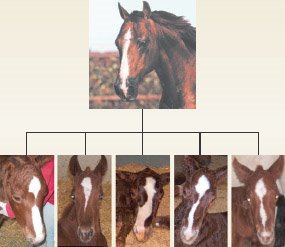
Two startling things can be said about the picture to the right, which shows two generations of a high pedigree race horse.
First, notice that there is no genetic father. Smart Little Lena stands alone as the genetic forbearer. The five horses pictured beneath Smart Little Lena are her clones, produced by surrogate mothers. That is startling enough, because it has been a long hard road to producing substantial numbers of horse offspring from adult somatic cells.
But there is something else that I hope has not escaped your attention. Ask yourself: do any of these kiddies look like their mother? (it might have helped if they had used a baby photo of Smart Little Lena ;-).
The clones don't even look like each other.
But don't go rushing to the conclusion that I am breaking a scandal about faked clones. These are clones, alright. Their obvious differences arise from what are broadly called "epigenetic factors". This is a nice neat term for a host of poorly understood mechanisms that affect how the genetic code, which is identical in all 6 horses shown, is translated into a living, breathing, animal.
The picture shows the state of the art in horse cloning. The situation would, in all likelihood, be the same for humans. Serious ethical questions aside, would anybody want to clone themselves under these circumstances? No matter what you look like, your cloned offspring could turn out looking just a little bit like Alex, Bogy, Camby, Dave and Eli.
Source: Publication by Stephanie L. Church, Nature Biotechnology 24, 605 - 607 (2006)

